
Custom Sterling Silver Jewelry: Weight and Wear
Gram weight is the least discussed and most felt specification in a silver order. A ring that matches its drawing but arrives a gram light will read as thin in the hand long before it fails at the bench. Since the published minimum is 50 pieces per design, a buyer can afford to cast two weights of the same design and compare them rather than argue from a photograph.

Key takeaways
- Weight and wear are one subject: thickness drives stiffness, and stiffness decides whether a seam opens.
- At 50 pieces per design, two weights of the same style can be sampled without doubling the design cost.
- Load concentrates at the clasp, jump ring and prong, so average grams predict failure poorly.
- 100% inspection means every piece is weighed, which catches mould drift that a sampled check misses.
Grams are a specification, not a detail
Two rings can match a drawing and still differ by a gram. The drawing fixes the outline; the gram weight fixes the substance. A shank that measures correctly in plan view can be thin through the section, and thin sections flex where thick ones hold.
The link between weight and wear is mechanical rather than cosmetic. Metal resists bending in proportion to its cross-section, so removing a tenth of a millimetre from a band costs more stiffness than the number suggests. A flexible shank also works its seams, and a working seam eventually opens or cracks.
The MOQ is what makes this testable. At 50 pieces per design, a buyer can order the target weight and a version 10% lighter, then hand both to staff for a week. That comparison produces a decision; a debate about a rendering produces a preference.
Weight also sets the plating surface. A lighter piece has more edge per gram, and edges are where a deposit wears through first. Reducing metal to save cost tends to move the wear problem to the parts a customer touches most.
Hollow, solid and sheet: three ways to lose weight
A solid casting fills the mould. A hollow casting uses a core that is removed afterwards, keeping the outside dimensions while cutting the metal inside. Sheet construction is a third route: a flat outline cut and formed rather than cast, which suits pendants and tags.
Hollow work is not automatically weaker, but it fails differently. A hollow bangle dents; a solid bangle bends. A dent cannot be polished out, while a bend can often be straightened, so the two constructions suit different wear patterns. A piece that meets a desk edge every day behaves better solid; a piece that hangs and swings can be hollow with no loss of life.
Sheet has its own tell. The edge of a cut outline is sharper than a cast edge, and it needs a separate finishing pass to soften it. Buyers who ask for "solid" without naming the route can receive a piece that is technically solid and visibly thin at the rim.
For 925 sterling silver, the construction choice also changes the mark. A hollow form has less wall to engrave, so an S925 stamp on a hollow bangle needs a position with enough thickness behind it, usually a flat inner face rather than a curved shell.
Wear points carry more load than the average
Average weight is a poor predictor of failure because load is not spread evenly. A clasp, a jump ring, a hinge and a prong each take forces the rest of the piece never sees. A chain that is heavy overall but finished with a light jump ring will fail at the jump ring.
So ask for gauges rather than totals: the wire diameter of the chain, the gauge of the jump ring, the thickness of the hinge knuckle. Ask whether the clasp is the same alloy as the body. A plated brass clasp on a silver chain creates a galvanic pair, and the join tarnishes before the chain does.
Comfort follows the same logic. A heavy pendant on a fine chain pulls the chain into the neck; the same pendant on a wider chain hangs flat against the collarbone. Distribution, not total grams, is what a customer notices after an hour of wear.
Type a search for sterling silver jewelry supplier China and the results blend casters, platers and trading desks into one list. Gauges are a quick way to tell them apart, because a supplier who quotes findings by diameter is working from a bench drawing rather than a catalogue.
Five lines that make weight enforceable
A tech pack needs five weight-related lines: target grams with a tolerance, minimum wall thickness, construction route, findings gauges, and the inspection that verifies all four. The table maps each line to the wear problem it addresses.
| Specification | What to write | Wear problem if omitted |
|---|---|---|
| Target weight | Grams per size, with an upper and lower tolerance | Light pieces that read as thin at the counter |
| Wall thickness | Minimum millimetres at the thinnest section | Dents at the edge, cracks along a seam |
| Construction | Solid cast, hollow cast or sheet, named per component | Dent where a bend was expected |
| Findings | Chain wire gauge, jump ring gauge, clasp alloy | Failure at the join, galvanic tarnish |
| Inspection | 100% weigh and dimensional check before packing | Mould drift found by the customer |
The inspection row is what makes the rest real. Every piece is checked rather than a sample, so a 50-piece order is weighed 50 times. That matters when a mould begins to wear, because the drift is gradual and the first pieces below tolerance are easy to miss in a five-piece spot check.
Tolerances should be two-sided. A lower limit stops light goods; an upper limit stops a supplier from adding metal to pass inspection, which raises weight and can change how a piece sits. A band that gains half a gram may no longer fit the same finger comfortably.
Write the tolerance in the same units the bench uses. Mixing grams and millimetres in one line invites a conversion error, and a conversion error at the sample stage becomes a full rework at bulk stage.
Worked example
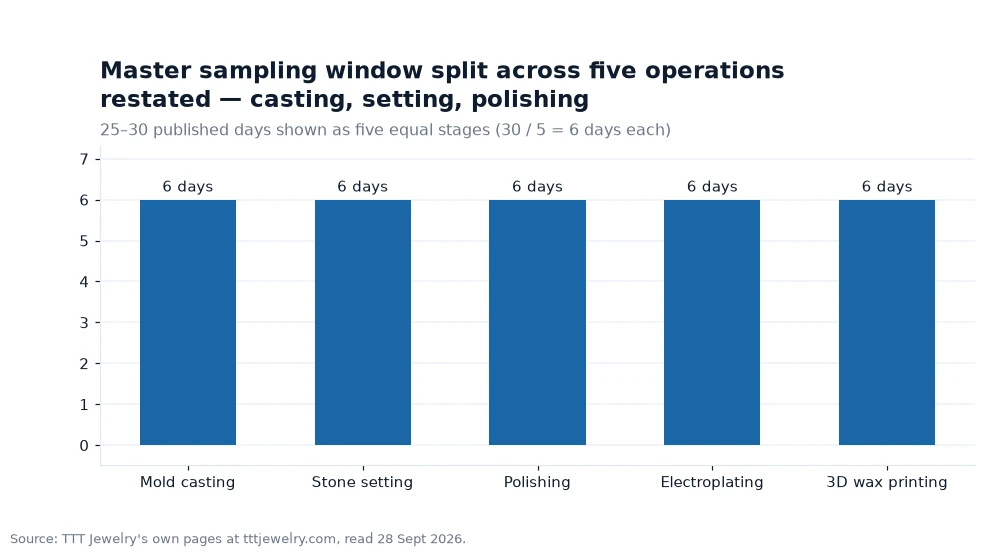
Start with the sampling calendar. Five bench operations — mould casting, 3D wax printing, stone setting, polishing and electroplating — at 6 days each gives 5 × 6 = 30 days, the top of the published 25–30 day range and equal to 4.3 weeks.
Now the weight. Suppose the tech pack sets 3.0 g per ring and the sample arrives at 2.6 g. The shortfall is 3.0 − 2.6 = 0.4 g, which is 0.4 ÷ 3.0 = 13.3% below target. Across a 50-piece minimum that is 0.4 × 50 = 20 g of silver missing from the order, and the buyer feels it in the hand rather than on the invoice.
Then the timeline. Two days of CAD plus 25–30 days of sampling plus 21–28 days of production gives 48–60 days. A corrected sample adds another 25–30 days, so a weight argument settled after approval costs five weeks and one more prototype.
Frequently asked questions
Is there a standard weight for a sterling silver ring?
No. Weight depends on size, width and construction, so the tech pack should set grams per size and the sample should be checked against that figure rather than an industry average.
Is hollow silver jewelry lower quality?
Not automatically. Hollow construction removes metal from the inside, but it dents where solid work bends, so the right choice depends on where the piece takes impact.
Why does a heavy chain still fail at the clasp?
Load concentrates at the findings, so a light jump ring or a plated clasp can fail before the chain does, whatever the total weight of the piece.
Turning an approved weight into a reorder standard
An enquiry that states grams, wall thickness and findings gauges gets a different class of reply from one that attaches only an image. The image fixes appearance; the numbers fix the product, and a supplier quoting against numbers has to think about the bench.
On repeat business the custom jewelry wholesale structure is where an approved weight becomes a standard, because reorders run from the same mould and the same sheet. The TTT Jewelry six-step flow is worth reading beside the tech pack, since each step maps to a document the buyer should already hold.
Keep the weighed sample, not just the photo. A number on a scale settles a dispute that a rendering cannot.
Source note: figures come from the manufacturer's own website (tttjewelry.com), read 28 Sept 2026.[1]